I stumbled upon an offer so cheap that I could not resist, a mini pizza oven fired by wood pellets. In the past, I had already looked at such a thing but at the time decided that it was not for me. Moreover i was experimenting with baking pizzas on a kamado. It has now become apparent that that doesn't work well, and because this was really cheap, I gave in.
unboxing
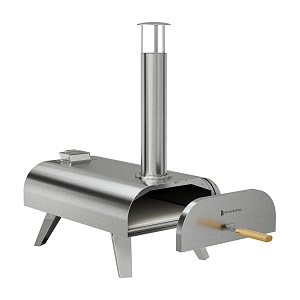
The oven is made of stainless steal, double-walled and comes complete with a 30x30cm pizza stone and a pizza peel. Some parts need to be screwed together but with one right hand it's doable.
Overall I wasn't disappointed at all; I expected something like a tin can, but it's actually quite sturdy sheet steel.
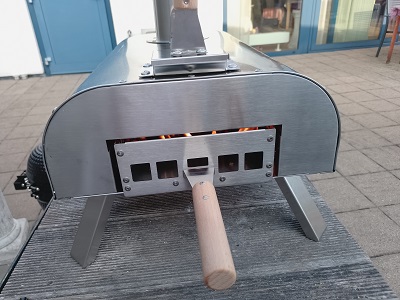
Sadly my oven had a design flaw; the fire tray was much smaller than the opening in the back of the oven. The result: much of the air drawn in went past the fire and not through it. This air is not heated and therefore cools the oven down. So the pizzastone neaver reached the desired temperature of over 400 °C. A modification was needed.
In this writing, I will make notes about operating this fun toy; hopefully, someone will find this useful.
THE PIZZAOVEN
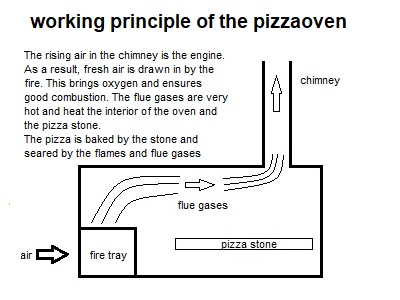
the principle of the working of the oven.
what is a pizzaoven
A traditional wood-fired oven has a a floor on which a wood fire is lit and a dome that directs the flue gases to the chimney.
A pizzaoven is similar to that but the dome is lower, causing more heat to reflect on the floor and pizza. When it is warmed up, the floor has a temperature of around 420°C and the oven environment 470°C. The pizza bakes due to the heat stored in the oven floor and is seared very quickly by the very hot environment inside the oven.
our mini oven
The operation of the mini oven is based on this same principle. The hot flue gases and flames roll mostly over the pizza stone. This causes the pizza stone to heat up. When the temperature is high enough, say over 400°C, the pizza is placed on the stone, receiving a lot of heat from it. The pizza base then bakes extremely fast. The flames above the pizza are very hot and sear everything very hard. As a result, the pizza is done in 90 seconds.
the design flaw, false air inlets.
burning problems
Keep the frontdoor always closed. If the oven is not burning properly, this is often because there is no good draft in the oven. There is a good chance this is caused by false (cold) air being drawn in. Ensure that all gaps at the back are closed so that only the fire can draw in air.
The photo shows clearly that the gaps beside the firedrawer can draw false air in. This air does not go through the fire and therefor it is cold and cools down the oven. The fire now gets not enough draft so it won't burn efficiently.
THE PIZZASTONE
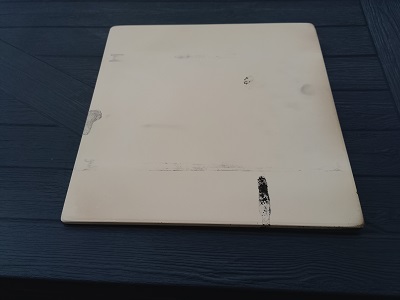
the fairly thin mullite pizzastone.
A very important (and vulnerable) part of our mini oven is the pizzastone, this is a ceramic slab that serves as the ovenfloor. The stone must be able to withstand high temperatures and is made of special ceramic called cordiite or mullite. And it must be able to store a lot of heat so that it doesn't cool down when a pizza is placed on it. The best stone would be quite thick, but this means long heating times and a lot of weight. Because of these drawbacks, the pizza stone is often quite thin and that makes it vulnerable. There are a few things to pay attention to in order to keep your stone intact and in good condition.
prevent thermal shock
If a cold object is placed on the stone, it is cooled down on the spot. If this cooling is too strong, a temperature shock occurs, which can cause the stone to crack. To prevent this:
Better not place a very cold pizza on the stone (why would you?)
if you wan to use a skillet, place it in the cold oven and heat it up along with it.
It might be possible to place a skillet on a thin wire rack like in your magnetron. When there is enough space between skillet and stone we should be able to warm it up safely. I need to experiment with this.
keep it clean and dry
Place nothing other than bread products directly on the stone. Make sure no pizza topping can drip off. Always make pizzas with a crust. Wipe the stone clean between baking pizzas so that the semolina doesn't burn.
If you leave the oven outside, keep in mind that the stone can become wet. Heating up a wet stone can cause it to crack. Let it dry at least 24hrs in a dry warm room. Do not do this in an oven.
cleaning
After the stone has been in use for a while, it will become stained. This is normal and harmless. Normally the stone will burn clean in the rest heat after the baking. If necessary you can clean the stone with the following in mind:
Always clean a pizza stone dry. Allow the stone to cool completely. Scrape away solid residue with a wooden or plastic spatula and wipe it clean with a dry cloth or brush. Never use water, soap, or dishwasher, as the porous stone will absorb these substances and may crack or develop a soapy taste. From a bacterial perspective, the stone is always clean due to the high temperatures.
the fuel
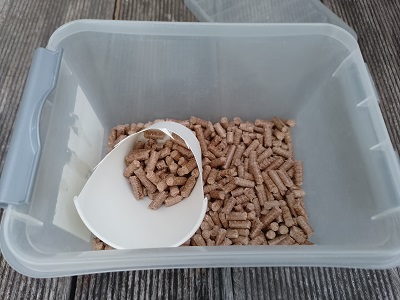
The pellets must be stored in a tightly sealable container.
Our oven is designed for pellet firing, but it may be worthwhile to experiment with, for example, a coconut briquette to prevent the fire from going out.
pellets
Wood pellets are small, cylindrical granules of compressed wood waste. They are made from by-products of the timber industry, such as sawdust, wood shavings, and wood chips. To be able to use them in the oven, they must meet certain requirements.
These properties ensure a long, very hot combustion without harmful substances and excessive smoke production.
prevent smoke
To minimize smoke production we should keep our pellets very dry. The way we burn them is also important. Add pellets bit by bit so that they never suffocate the fire.
Pellets burn quite quickly, resulting in flames. This creates a very hot oven environment.
to avoid
Absolutely do not use cheap pellets for household pellet stoves; these may contain softwood, binders, or glue residue that are unhealthy and give your pizza a bitter taste.
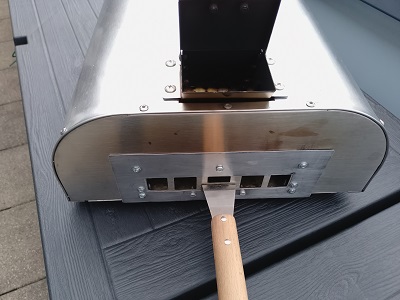
The opening in the back is now completely covered. Not possible to ingress false air.
One of the things we must do judiciously is stoking up the oven. We do this with the help of firestarters or a gastorch.
provide oxigen
To prepare our oven we should see to it that the fire gets enough oxigen. We close the frontdoor and make sure that the chimney is open. Any draft regulators must be open.
firestarters
The right ones are made of pure wood and plant-based wax. They are completely odorless and leave no chemical taste behind.
Never use petrol based tablets or liquids like lamp oil, spiritus, etc, this wil soak into your stone.
Put a firestarter in the firetray and form a small pile of pellets around it. Now lite the starter. Initial you can do this in the open but with wind you put the tray in its place. When a little warmth is developped, the draw in the oven starts and that provides the oxigen and prevents smoke. When the is a signifficant fire, we can add pallets bit by bit. Wait with every addition until it burns. In this way we can we prevent smoke development and nuisance to the neighbors.
check temperature
After minimal 20 minutes we can check the temperature of the stone. We do this with the help of a laser temperature sensor. The clock that some ovens have is not vey accurate and tells us nothing about the stone temperature.
If we open the door we should see flames rolling allong the roof. If the stone is over 400°C, we can put our pizza on.
important
The air that is drawn into the oven should really pass through the fire. This air feeds the fire with oxigen and the flue gases then enter the oven with a very hig temperature. If there are gaps and crevices through which false air can be drawn in, you will have to deal with fire strangulation, smoke, and poor heating.
The photo shows the stainless steel sheet metal plate i mounted to completely cover the gaps in the backwall. The only inlet is through the fire.
BAKING
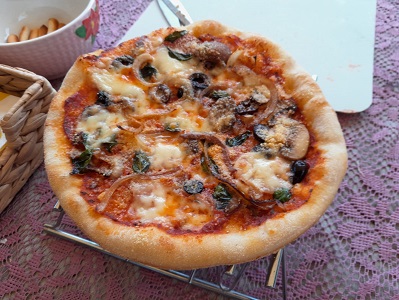
A sort of pizza capricciosa with artichokes.
Something to keep in mind: the more hydration the pizzadough has, the more water is evaporated which cools off the pizzastone.
Baking the pizza really needs some finesse. We have to control various processes simultaneously. We must keep feeding the fire, bake the pizza and prepare the next one. So when we put the pizza in the oven, we have 50 seconds to stretch the bottom of the next one. Then after turning, we would have 40 seconds to put some topping on it. It takes some experience to do this efficiently. It might be wise to time some actions, so you know, for example, that stretching takes 50 seconds, so then turn the pizza.
maintain temperature
It is important that the stone is sufficiently hot. If this is not the case, the pizza will scorch on top while the bottom is not yet cooked. So there is really a balance between pizzastone temperature needed. After baking a pizza, there is a risk that the stone cooled down too much. Especially when we have a thin stone. So it is always wise to wait a couple of minutes before the next pizza. I would suggest: add some pellets and start to prepare the next pizza. When this is done, the stone may be ready to receive it.
speed
It is important to work quickly and efficiently. At these temperatures, sloppiness is immediately punished. See to it that your workspace is cleaned from unnecessary objects and that there is enough free space to put f.i. the oven door down. It is very hot!
Be sure that the pizza is not sticking to the peel, use enough semola and don't let it rest too long on the peel. When the temperature is right, place the pizza on the stone and close the door.
turning
When the pizza is in the oven we can't afford any sloppiness. We should already know how we can turn the pizza, do we need to draw it out or are we handy enough to do this with a smaller peel. Try practicing this in the cold oven with a round object to get the hang of it.
Remember, we only have 90 seconds. After some 50 seconds we turn the pizza 180 degrees so that the part that was initially closest to the fire is now near the door.
Inspect the condition; if it is already quite scorched, it certainly doesn't have much longer.
points to note:
ensure that as little semolina as possible gets on the pizza stone. Always shake the pizza well off before adding toppings. Wipe the stone between two bakingsessions as semola on it will burn, which is not conductive to flavor and smoke development.
Make sure your pizza has a rim so that no toppings can get onto your pizza stone. This burns immediately and creates an unpleasant taste and smoke.
OTHER
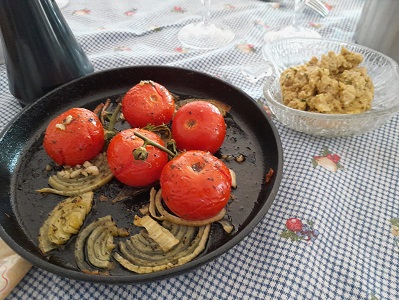
example of using a skillet.
We can make other food in the oven, f.i. grilled vegetables or sear a steak.
Use a skillet, warm it up in the oven (never put a cold skillet directly on the stone), and put the chopped vegetables mixed with some sunflower oil in it. After a minute, flip the vegetables and give them some more time.
Here are some veggies that give great result.
Green asparagus tips: They are thin, cook in 2 to 3 minutes, and acquire a delicious nutty, roasted flavor from the flames.
Bell peppers and onions: Cut them into coarse strips or rings. The edges char beautifully black (creating that typical sweet BBQ flavor), while the inside retains a nice bite.
Courgette and eggplant: Cut them into slices about 1 centimeter thick. They absorb the olive oil well and sear to a beautiful golden brown.
Bimi (Asparagus broccoli) or broccoli florets: Cut them into very small pieces. The small leaves at the top become super crispy from the rolling flames, as if they were deep-fried.
Cherry tomatoes (on the vine): Place them whole in the dish. The heat causes the skin to burst open and the sugars inside the tomato caramelize. This creates an explosion of flavor.