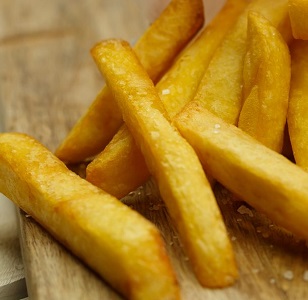
For years, I have been experimenting with frying fries. I was unable to achieve a consistent and predictable result. I had always thought that this had to do with the season. The available potatoes are most of the time harvested in the previous year and therefor their condition changes with their age. I have a preference for a certain type of potato, the "Agria," which is perfect for fries. For me they are however difficult to fry beautifully crisp.
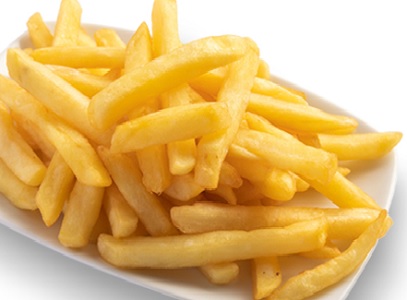
What exactly are perfect fries? For me they are a beautiful golden yellow, not pliable, and have a thin, crispy skin. From close up, you see blisters on the skin. And you see fries that have been fried in a curved shape. The fries never taste like heavily used fat.
With regard to crispness, I learned that the greatest enemy of crispy fries is moist. The taste depends on the potato variety and the fat used. This method is therefore aimed at:
getting rid of as much moisture as possible.
protect the taste of the fat.
supplies
The main things we need are a good deep fryer, suitable potatoes, and fat.
the potato
The ideal potato has the following properties:
High starch content (floury/crumbly): Starch ensures that the inside becomes nice and soft, dry, and floury during frying.
Low moisture content: Too much water in the potato steams the fries apart from the inside, causing the crust to become soggy instead of crispy. Floury potatoes lose their moisture faster during pre-frying.
Low sugar content: If a potato contains too many reducing sugars, they caramelize too quickly in the hot oil. The fries then turn dark brown or burn on the outside before the inside is cooked.
Size and shape: An elongated shape is ideal for cutting beautiful, long Belgian fries or French fries.
the fat
The fat has a big influence on the taste.
You can use various kinds of fat. I use vegetal frying fat from the supermarket. Some prefer animal fat, such as "ossenwit". This is a matter of taste and budget.
conditioning the fat
The taste of the fat will diminish after each frying. Especially at high temperatures, unavoidable contaminants can burn. With a few measures, we can keep our fat in condition:
I never fry anything else than my own fries in it. Definitely no pre-fried frozen fries from the supermarket. This will ruin the taste immediately.
I always use a deep fryer with a cold zone, below the heating element.
Avoid small potato particles ending up in the fat where they can burn.
Never keep the fat unnecessary on a high temperature. When finish-frying the fries, put them in the pan immediately when the temperature is reached.
PREPARATION:
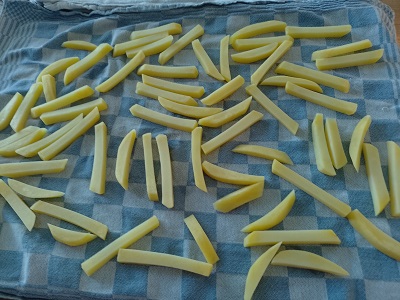
the cooked fries spread on towels to steam dry
I assume that one two-persons portion can be baked per batch. So the following instructions are for 2 people.
To get rid of a.m.a.p. moist I follow the next steps.
cutting
First, we peel the potatoes. Next, we cut them into slices of the desired thickness. We then cut the slices into square sticks. Try to avoid getting thin, pointed ends that can burn easily.
moist extraction
The ideal potato has a low moist content. We can extract moist from the fries by soaking them in cold salted water for an hour. This effect is called osmose, the water flows to the agent with the highest salt concentration. I usually add so much salt that i can clearly taste it. I rinse them well The result after one hour is slightly pliable fries. Moreover, we have gotten rid of all the released starch that could contaminate the frying oil.
texture fix
We place a pan on the stovetop with water and dissolve 2 tablespoons of vinegar per liter in it. When this boiles
we put the rinsed and drained fries in, wait until it boiles again and let it boil for 4 minutes.
After that we let them drain and spread them out on a dry tea towel to steam dry and cool down.
This step fixes the pectin structure in the potato so that the fries remain firm. You will end-up with nice dry cooled fries,
that are somewhat less fragile and vulnerable.
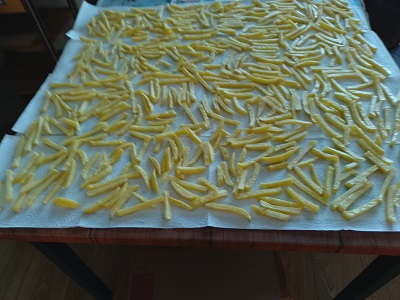
the prefried fries spread on paper towels
pre frying
So now we have blached fries that lost much moist already. We are going to pre-fry them now.
I prepare a layer of newspapers covered with paper towels on the kitchen table.
I put the fries in the fryer at a low temperature (140 C) to pre-fry them. This is is finished when the fries start "singing" in the fat and float to the surface. Useually this takes some 5 minutes.
After frying i spread them on the kitchenpaper to cool off completely.
FREEZING:
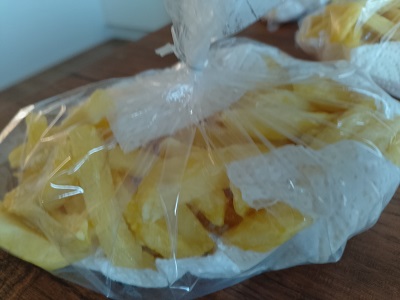
reaady to go into the freezer
The next step is freezing the fries. We do this because the result will be more crispy.
deepfreeze
We put the cooled fries in a bag with a sheet of kitchen paper towel. Now we place the bag in the freezer, at least until completely frozen. This has the following effect:
Retrogradation: This causes the outer layer of the fries to transform into a kind of hard, glass-like structure. When finished frying at 190°C, this layer fries up into a wafer-thin, brittle crust.
Moisture: The cold, dry air in the freezer draws the last active moisture out of the outer layer of the fries (sublimation). Since water is the greatest enemy of a crispy crust, this is essential. The moist is absorbed by the kitchenpaper.
Freezing causes hairline cracks in the surface, resulting in a crispy layer later on.
I start with the highest remperature because because the cold frozen fries will cool the fat considerably. You even have to wonder if the temperature is back to level after this baking round. I set the highest temperature on the deep fryer (190 °C) and wait until the heating light is out.
final fry
Meanwhile, I empty one bag frozen fries in a bowl and check if there are no ice crystals. Now I place them in the fryer and fry until a very slight brown appears. Now the fries are ready and can be taken out of the oil. This usually takes 3 to 6 minutes, depending on the thickness. During this time keep an eye on the temperature and don't let it become over 180°C
Please note: Different potato varieties also have different aspects when they are ready. The decision that they have baked long enough is based purely on experience. The potatoes i use (Agria) have a nice yellow color of their own. Because of the low sugar content they hardly get brown.
You can judge if they are good when shaking them. You should be able to hear that they are crispy and you can see the blisters on the skin. Do not bake them too brown, this wil ruin the taste and spoil your fat.
With this process, I get delicious, flavorful, and crispy fries. They even stay crispy after sitting for a while. Exactly how i like them. There is one downside however. When we make fries for 2 persons this works perfectly but After frying one round, we need to wait until the fat is back on temperature. This may take too much time.
serving
Where I live, fries are preferably eaten with mayonnaise or fry sauce. In my opinion they can be eaten even without that.