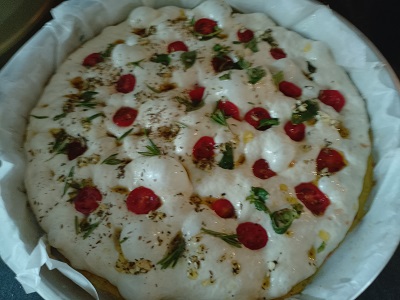
One of the delicious kinds of italian bread is focaccia. This is a traditional Italian yeast-leavened flatbread. It is characterized by its thick, airy interior and a golden, crispy crust. It is useually baked at 220°C. in a baking tin. Before baking, bakers press their fingers into the dough to create signature dimples or wells. These dimples trap generous amounts of olive oil and coarse sea salt, keeping the bread incredibly moist and flavorful.
While it is delicious plain, focaccia is frequently topped with aromatic herbs like rosemary, or embedded with ingredients such as cherry tomatoes, olives, onions, and garlic. It is versatile enough to be served as an appetizer, a side dish for soups and salads, or sliced horizontally to make gourmet sandwiches
info
A focaccia of 125gr (average 275 to 325 calories) is the equivalent of 2 or 3 sandwiches.
THE FLOUR:
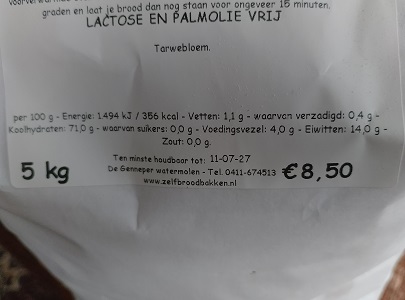
the label of a Dutch flour "nedertarwe" with 14% protein.
The most important ingredient is flour, and a few specific requirements are placed on it:
must be made from soft wheat (grano tenero)
super fine and pure ground
Gluten strength (Protein content)
the wheat
Soft wheat ensures supple gluten that stretches easily.
the grind
A fine pure grind ensures that water is absorbed very easily into the dough. The absence of bran particles makes the dough more cohesive and gives a better baking result.
gluten
The flour should contain enough protein to ensure that we get a very elastic dough (at least 11.5% - 13.5%). The more protein, the more hydratation and longer rise time.
additives
Some flourtypes contain enzymes(Amylasen en Xylanase), these flours are not suitable for indirect dough with long rise.
So what flour should we use?
The italian 'typo 00' is the best, the Italians say. The lokal mill shop has pizzaflour with 12,8% protein.
American Patent with 14% or 'nedertarwe' patent with 14% protein. When we mix this with patent flour from the supermarket, we get 12%-12.5% protein and very fine grind. This way we can save us some money.
Manitoba with 14.5%, a very strong flour that can handle high hydration. Very good for indirect dough.
Superflour with ascorbine acid an enzymes for a direct dough
high proteine flour
If we use high-protein flour (>13.5%), we must take into account:
The dough can have a high hydration
very long rising times (24 to 48 hours in the refrigerator).
The dough may be too stiff to fill the baking tin.
So this has not much advantages, better to mix it down then. Example: one part 14% and one part 10% (supermarket patent flour) gives us 12%
USING BIGA:
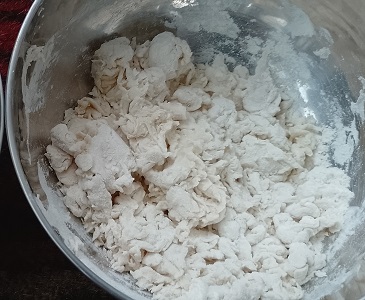
biga, a very dry pre-ferment.
We speak of indirect dough when we make it with a pre-ferment. This will improve the taste of our bread. In case of a focaccia, the favorite is "biga". This is a dry dough with 50% hydration that we make 24 hours before we make the actual dough.
flour mix
If we have four mix of 50% manitoba with 50% ordinary patent flour, we allways make the biga with the strongest flour, the manitoba. This complicates the calculation somewhat.
Calculation for biga
Say we want to make an indirect dough from 500 gr flour with a hydration of 75%. That means we need 375gr water. And 2% salt = 10 gr. We can make a biga of 200 gram flour and 100 gr water. We mix this together with all the yeast we need in our final dough. Don't knead, as we don't want to have gluten! And let it sit for 24 hrs at cool room temperature 16°C. Is our roomtemperature is too high we put it in the refrigerator after 3hrs.
The next day we take 300gr flour and 275gr water and mix this with the biga. After mixing we add the salt. So now we have a dough with total 500 gr flour and 350gr water.
TIP: The biga can be a bit hard to mix in the final high hydrated dough. A trick is: First devide the biga in small pieces and knead a bit of the remaining water and flour in it. When it becomes porridge-like, add the rest of the water, flour and salt. Make sure there are no lumps left in the dough. The oil is added last.
THE DOUGH:
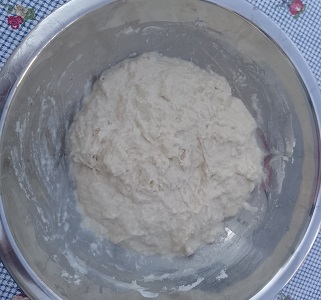
the dough with biga after mixing.
The most important ingredients are water and flour. Their ratio depends on various factors: How much water can the flour absorb, we dont want to end up with a liquid dough. In case of a focaccia, a characteristic of the dough is the high degree of hydration (75%). There is so much water in it that it is impossible to kneat.
Instead, we apply the "stretch and fold" technique to build the gluten network. The result is a very airy dough with large gas bubbles.
The other ingredients are yeast, oil and salt.
hydration
Hydration is the weight ratio of flour to water. 100 grams of flour with 60 grams (ml) of water gives 60% hydration. The more proteine in the flour, the higher the hydration can be to obtain a fine very soft but stil elastic dough. As mentioned above, for focaccia we want 75% hydration.
So when we use the flour with 12,8% protein from the mill store, we can target at a hydration of 75%. The ingredients for 500gram dough are:
285 gram flour with 12,8 proteine
214 gram tapwater (cold for long rise)
5.4 gram fine seasalt (average salted)
2 gram dry yeast (1/2 teaspoon)
2 dinerspoons of olive oil
To round, take 300gr flour, 225gr water, 6 gr salt, 2 gr yeast and 2 dinerspoons of olive oil.
mixing the dough
Pour almost all of the water in a bowl and add yeast and flour.
Stir this with a spoon until a more or less homogeneous mass is obtained. Now you can add the salt and the rest of the water. The oil comes always last after the initial mixing, as this doesn't help the gluten. Some peopla say that first an autolyse should be alowed before the oil addition.
stretch and fold
Let the dough rest for 15 minutes after mixing. Now we should have a dough that is too sticky to kneed. Insteat perform a stretch-and-fold every 15-30 minutes for up to one or two hours: take one side of the dough, stretch it upward, and fold it over the rest. Turn the bowl a quarter turn and repeat this 3 times. Now cover the dough and repeat this after 15 to 30 minutes.
In total you do 4 rounds of strech and fold.
TIP: do this with wet hands otherwise it will get messy.
refrigerate
During this time, the dough can grow in size, be sure your bowl is large enough. Cover the bowl or put the dough in an generously oiled and covered food container. Now put it in the refrigerator for 24 hours.
The next day, remove from the fridge and put it in a baking tin.
baking tin
This is preferably a thin metal tin. Heavy containers warm-up too slow in the oven, the dough will stick. Use baking paper then.
Generously oil the baking tin. Pour the dough in it and fold to a shape more or less of the baking tin. Gently stretch it a little to fit in the tin.
Now let it sit to come to room temerature and let it rise for 1 to 3 hours until the surface is bubbling and the tin is filled.
We have the baking tin filled with our dough that has risen enough. Now we spread 2 dinnerspoons of oil over it. With our 5 oiled fingers together we stab holes in the dough.
basic
In its basic form we spread some rosemary over the surface, push it a little down here and there. We can also use oil that is infused with herbs like thyme, oregano, rosemary, garlic, etc. Sprinkle some seasalt over the dough.
Just use your phantasy.
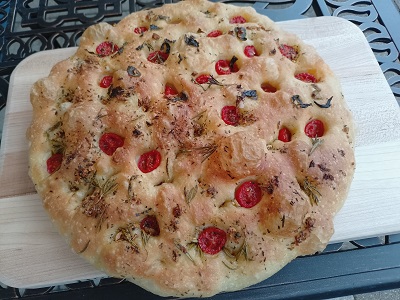
The focaacia in the photo is topped with small tomatoes, rosemary, italian herbs, oil with chopped garlic. On one part i sprinkled some cumin. Very tastefull.
The baking
Be sure that you added the desired topping and sprinkle some seasalt over the dough.
We have the oven pre-heated, we can bake it, 20-25 minutes at 220°C.
Once the focaccia is baked, and has become golden brown, remove the pan from the oven and let it cool a bit so that we can handle it. Best is to transfer the focaccia from the tin to a wire rack where it can evaporate some moist.