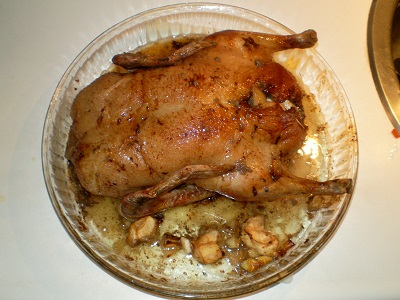
One of my favorite dishes is roasted duck, actually a very simple dish that anyone can make. In my country duck is not a popular dish so we have to go to Germany to buy one. Or to the Chinese supermarket where they sell "peking duck", specially bred for fat.
hardware
The most important thing we need is an oven that can reach a temperature of 200°C.
Beside that we need a baking dish that is not too shallow and that the duck fits in. It will lose a lot of fat during roasting, we want to capture that instead of it burning in the furnace.
PREPARATION:
In most cases, our duck will be deep-frozen, so the first step is to defrost it. I like to let nature do that but sometimes i give it a little magnetron treatment to help. When the duck is at roomtemperature we consider it to be defrosted. This will take 6 hrs depanding on the ambient temperature.
Keep in mind that once defrosted, we should roast our duck a.s.a.p. Because if it comes from China, we must be careful with hygiene. Also carefully clean-up moist that comes from the duck and don't let it sit unnecessary at room temperature.
Dry the duck well, both inside and out. Next sprinkle it generously with salt. To taste white peper. Sprinkle the pepper and salt on both the inside and the outside.
ROASTING:
A noodle meal bowl is ideal for one pizzaball.
We want to get the duck nicely roasted, so that the outside is brown and the flesh is not dried out. Thefore, the heat treatment in the oven has 2 settings, the temperature and the time.
Both settings determine how quickly the heat reaches the inside of the meat.
temperature
In theory, when we want our duck to have a temperature of 70-75°C. we can put it in an oven of 75°C. If we wait long enough, our duck wil eventualy reach this temperature. It wil not have any maillard reaction, so no delicious smell, and the fat will not be melted. I wil be very juicy though.
So at least a part of the oventme, the duck should be exposed to a fairly high temperature, say 180°C.
oventime
The speed of transport of heat in material per timeunit is the result of difference in temperature. So if our duck has a kernel temperature of 20°C. and the oventemperature is 180°C. the transport is much faster than when the oventemperature is 100°C. Also, as the kernel temperature rises, the transportspeed slowes down.
balance
The best practice is to use a thermometer to measure the temperature in the thick fleshy parts. The heating strategy is often a result of experience. When i have a duck of 1700gr. i do the following:
I put the duck in a baking dish, place this in the oven and set it to 200°C. and time 45 minutes.
I lower the temperature to 170°C and let it roast for another 25 to 35 minutes.
I let the duck rest at least 10 minutes under alufoil or in the oven with the door slightly opened.
We can do a number of things to improve the crispness of the skin. Why would we do this:
Taste and texture: Fatty duck meat requires a crispy counterpart for a delicate texture in the mouth.
Reducing fat accumulation: Crispy frying melts away the thick subcutaneous fat, making the duck taste less fatty.
Flavor retention: Crispy skin locks in the meat juices better, ensuring the meat remains deliciously tender.
baste with its own juices
During the last 15 minutes, spoon the hot, melted duck fat over the breast a few times.
use the grill
Switch the oven to the grill setting (top heat) for the last 3 to 5 minutes and stay close by to prevent burning.
glaze with sugars
For the last 10-15 minutes, brush the duck very thinly with a mixture of honey (or maple syrup) and a drop of soy sauce; the sugars will caramelize and become crispy. You can repeat this 1 or 2 times.
Pricking the skin
Gently prick the fatty areas of the skin with a toothpick (without piercing the meat) so that the fat drains away more easily. You can do this at the start or halfways. Carefull: no NOT pierce the meat as it will dry out then.
peking duck
Here is how in some cultures the duck is handled before roasting. You might find it worth giving it a try.
In china, before roasting, the duck is dipped in boiling water or poured over. They do that for following reasons:
The skin shrinks and tightens. Duck skin contains a lot of collagen (connective tissue). Due to the sudden heat of the boiling water, this collagen shrinks immediately. As a result, the skin tightens and becomes smooth around the duck. This ensures that the duck bakes evenly brown and crispy all over in the oven later on, without wrinkles.
The subcutaneous fat melts in advance. Ducks have a thick insulating layer of fat directly under their skin. The boiling water causes this fat to start melting. This allows the fat to drain away much faster and more easily in the oven later on. If you do not do this, the skin remains soggy and greasy on the inside.
The pores close for glazing. The boiling water seals the surface of the skin. This is crucial for the next traditional step: glazing the duck with a mixture of water, malt sugar (or honey), and vinegar. Because the skin is tight and dense, the sweet marinade does not soak into the meat but remains on the outside as a perfectly thin film. This film then dries out and caramelizes in the oven to that glossy sheen.
How they do this in China: Often, the duck is not even fully submerged; instead, they hang it from a hook and repeatedly pour boiling water over it with a large soup ladle until the skin turns completely white and is taut. Then, they let the duck dry for hours (sometimes up to 24 hours) in a cool, drafty room before it goes into the oven.
the duckfat
When our duck is done, we likely have a considerable amount of liquid in the baking dish. You can pour this into a bowl, let it cool, and place it in the refrigerator. The next day, we can easily separate the jelly and the fat.
the jelly
This dark duckfont is an absolute goldmine for the kitchen. Stir it into a warm gravy the next day, use it as a base for a soup, or mix it into a stir-fry for a huge flavor boost. I always eat it, i find it irresistable.
the pure fat
The fat remaining after the jelly has separated is now very pure. It will easily keep for several months in a sealed jar in the refrigerator. You can even freeze it.
the duck fat has a high smoke point. It is the secret ingredient for making the most delicious, crispy fried potatoes or roasted vegetables in the pan or oven.