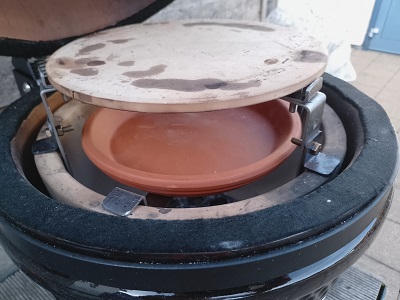
 the heatdeflector and pizzastone rack.
I bought me a 13" kamado and had fun cooking a smoky ribeye on, or rather in it. Now i wanted to investigate if it is possible to make a pizza in it.
I already knew that i needed a pizza stone for that. But there is more to it. I understood that another important piece of hardware is needed, a heat deflector. Without it, the pizza stone is directly heated by the charcoal fire. That would mean that it becomes very hot, while above the pizza the temperature would be a lot lower. This means the pizza would likely burn on the underside and would't bake on the top.
So what we need is a shield between the fire and the pizzastone that does not obstruct the heatflow too much.
Moreover we need to place the pizzastone higher in the dome where the temperature above the pizza would be higher. Now the pizza is exposed to a very high overhead temperature en would cook more evenly.
Since for my kamado model nothing suitable is on the market, i decided to make this myself.
Here is how i made this work.
GENERAL THOUGHTS
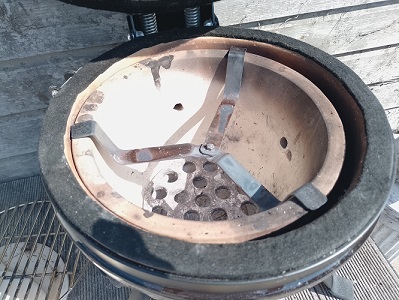 this is the rack for the deflector.
The most important thing we need is a very high temperature oven, i consider 350 °C the minimum.
To replicate the conditions in a wood-fired oven, we need a pizza stone. Furthermore we must ensure that there is enough overhead heat otherwise the pizza will only bake (or burnes) on the bottom while the top is not cooked.
In the kamaro we accomplish this with the help of the heatdeflector. It is very important that these components are not obstructing the airflow. With insufficient draft in the kamado, the temperature cannot get high enough
Wat we want is to hang the shield somewhat lower in the firebox and have the pizzastone somewhat higher in the dome, where it catches more overhead heat. So i decided to make 2 modifications: The heat deflector and a rack for the pizzastone. The photo shows what this looks like.
HEATDEFLECTOR:
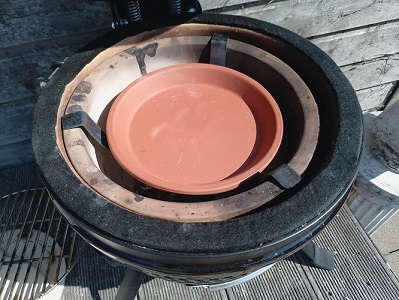 the heat deflector with terracotta saucer installed.
We need a piece of ceramic or cast iron that has enough mass to prevent it from going to glow, which would make it ineffective.
what to buy
The easiest way is to make a rack on which we can place the actual shield. The rack can be made of 20x2 steel strip and rests on the top of the firebox.
On the rack we can have a terracotta plant saucer or a cast iron skillet. Because the inner diameter of the firebox is about 22.4 cm, our shield should ideally have a diam. of about 17 to 19 cm. This leaves a 1.5 cm gap around so that the airflow is not obstructed. I found a suitable terracotta saucer of 19cm.
my shopping list:
- 3 strips of 20x2mm length 18cm each
- stainles screws and nuts
- a cast iron pan or terracotta soucer of 19om diam
I have chosen this material because it is fairly ease to drill, saw and bend.
bending the strips
To make sure that the level of each strip is equal we start with bending a bajonet in the strip 2 cm from one edge.
The 1st bayonet has a height difference of 2 mm, the next 4 mm and the 3rd 6mm. We want the center hole 1 cm fom the edge.
This means that the bend towards oblique vertical up comes at 9 cm from the edge. The bent takes an extra 10 mm so the total diameter of the rack now is 20 cm and wont touch the side of the firebox.
The sketch shows what the idea is. When bent, we can drill the holes in the legs.
 The deflector with a terracotta plant saucer
the pan
When we use an iron cast skillet, it has probably a grip that needs to be sawn off. This is fairly easy to do. When ready be sure to file down the sharp edges.
I bought plantsaucer of terracotta, diam 19cm. This is very cheap and works very good.
conclusion
the rack for the pizzastone.
The idea is to place the pizza stone slightly higher in the dome. Then the heat would reflect better off the hot dome. Also the stone is further away from the heatsource. In theory the stone should be colder and the overhead temperature higher.
I made a rack that alows me to put the pizzastone at dfifferent heights in the dome.
This design allows to experiment with the height of the pizzastone to see what gives the best result.
usage
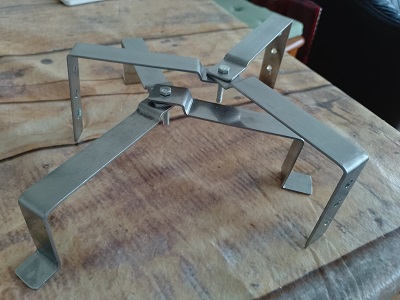 the results of a morning benchwork.
So how do we use our modifications. Below it is explaned.
grilling
For this dont need any of this modifications. The grill rack rests directly on the rim of the firebox.
low and slow
For this we need the heat deflector. Pack the shield in alufoil so that leaked fat and juices won't soil it too much.
Now we can tune the temperature down at say 130 degrees C.
pizza baking
For pizza baking, we hang the iron rack in its place in the firebox. It is adviced to pack the saucer in alu-foil to prevent dirt or fat penetrating the terracotta. Optional we can put some lightly pressed balls of aluminum foil in it if we think that the pizzastone is too hot.
This forms some insulation for the pizza stone.
We also place the pizza stone holder on the edge of the firebox so that its position is higher in the dome.
testing
When i bought the kamado i only had 2 half moon ceramic plates that cover the firebox completely. Useless as they obstruct the airflow too much.
With this construction we highly extended the options for cooking in the kamado. We now can:
- keep the kamodo on a low temperature to slow cook a large peace of meat, eventually with smoking chips
- bake a pizza or bread using the pizza stone
- direct grill above the charcoal
The first test was to heat the kamado to a very high temperature to see if the terracotta dish remained intact. It did. Next i baked a pizza with the pizzastone rack in its lowest position. That was a very tasty success but the crust was a little pale. I think that the overhead heat should be better.
So wat can i try next:
- put balls of alufoil in the soucer, this might lower the temperature of the stone.
- lift the stone some more centimeters, it could be that the higher in the dome, the higher the overhead temperature is, or there could be more heat reflection.
pizza baking
- with the stone direct on the original grill rack: was certainly not bad but the crust was still a bit pale.
- with the stone as high as possible in the dome: The same result.
-
lower the stone temperature
We can try to lower the temperature of the stone by putting loosely pressed balls of aluminum foil in the terracotta saucer. This way there is less airflow under the pizzastone so in theory the temperature should be lower. This means it costs more time to bake the pizza, so the upper side is longer exposed to the high temperature in the dome. This is however certainly not the real pizzabaking.
conclusion
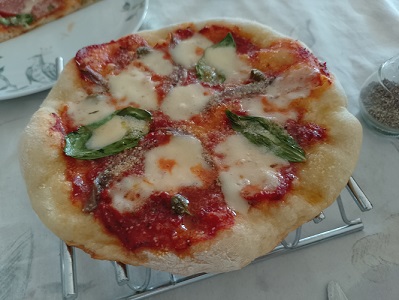 a freshly baked pizza, delicious but too pale.
I baked several times pizza in this kamodo, using all possible modifications. But no matter what I tried, I never got the pizza as nicely charred as in a real pizza oven. When the base was cooked, the top was always pale.
Alhough the taste of these pizza's was certainly not bad, it was not the real thing. So I have to conclude that a small kamodo is not suitable for this purpose. There are people who proudly photograph their brown pizzas, but presumably they baked a longer time and therefor have a very hard crust. So you are probably better off with a woodpellet-fired mini pizza oven.