It is summer and the weater is fine. Time for the barbeque. Because I recently moved, I need to buy new BBQ hardware. After thoroughly researching the subject, I bought a small kamado.
I had fun cooking a smoky ribeye on it, or rather in it. Baking a pizza was another challenge.
I also bought a japanes ceramic table grill (shichirin).
These bbq's serve different purposes and place specific demands on the charcoal to use. That is why I also had to delve into the world of charcoal.
This document helps me organize and remember all the ins and outs of this subject. I hope it can be of value to others as well.
GENERAL THOUGHTS
some theory
We prepare food by adding heat to it. This can be done in various ways: In this context 2 ways are relevant:
- radiant heat, which is basically intense infrared light. Example: If you sit close to the campfire, you feel the warmth shining on you.
- convection heat: the heat is transferred by a medium. Example: Hot air transfers heat to colder objects like food.
Barbecuing is preparing food using charcoal. We can distinguish two basic methods:
grilling
Grilling is heating direct above the coals. The heat glow shines directly on the food. This way the food is exposed to a lot of heat. You can compare this with an electric grill, the heat comes fom a glowing hot element.
indirect heating
With indirect heating, the heat radiation from the coals does not shine directly on the food. This is achieved by placing an opaque obstacle between the glowing charcoal and the food.
The fire produces flue gases that can be very hot. food is now only heated by the hot gasses inside the BBQ. The heat intensity is lower.
THE KAMADO:
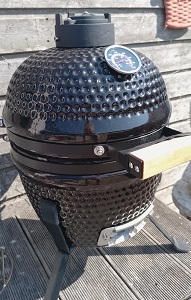 the 13inch mini kamado.
The kamado can be used as a sort of hot air oven but also as a grill. If we use it as a grill, the food is exposed both to the hot air and to the charcoal glow. The heat is very intense.
If we want a hot air oven we place a heat deflector between the coals and the food. This way we can cook in the low and slow mode.
the charcoal
The kamado works best with somewhat coarser chunks of charcoal that produce little ash. This allows oxygen free circulation and the temperature can be regulated better. For low and slow we wouldn't need a very high temperature but we need a long burning time.
For questions you can mail to
hansiart@upcmail.nl
THE SHICHIRIN
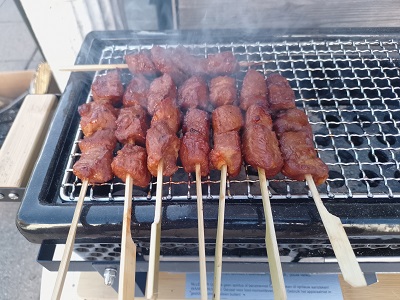 the shichirin with delicious sate.
This is also a ceramic oven, but it has no lid. This means that we can only grill with it. This requires a special charcoal that is very hard and burns long and evenly with a high temperature output. The charcoal The Binchotan is the adviced brand but there are cheaper alternatives. It has to stay a bit fun after all.
The idea behind this BBQ is to grill small pieces of meat or fish together at the table at very high temperatures.
The photo shows the shichirin in action. In this case i used coconot briquettes because the sate is too thick to grill at very high heat. You can see that there is a "cold zone". This saves fuel and we can provide some indirect heat to the food.
the charcoal
For most purposes we want coal that has a long burning time and does not produce much ash that can suffocate the fire. Also the burning temperature temperature can differ between the different types. To keep in mind: The harder the charcoal is, the longer it burns but the harder it is to light.
Below we discuss some types of charcoal and their specific properties.
- Binchotan: Gives off extreme heat, a long burn time, and virtually no smoke or odor. Is very expensive and hard to obtain. Special for the Shichirin. Not easy to light
- Ogatan: Tubular briquettes with a hole in the center, made from 100% compressed sawdust from hardwood or fruitwood. Properties: It burns very steadily, emits stable, high heat, and produces hardly any sparks, smoke, or odor. Easyer to light.
- quebracho: also a hard type charcoal. is sold in large chunks, has a long burning time and high temperature. Brings a strong smoky flavor!
- Marabu: is a heavy, compact type of charcoal from Cuba. It burns for an incredibly long time and gets glowing hot, just like Binchotan. Brings little smoketaste to the food.
- High-quality Coconut briquettes: Burn long and consistently, produce little smoke and ash, although they do not reach the extreme heat of Binchotan. They hardly flare up if liquids leak on them.